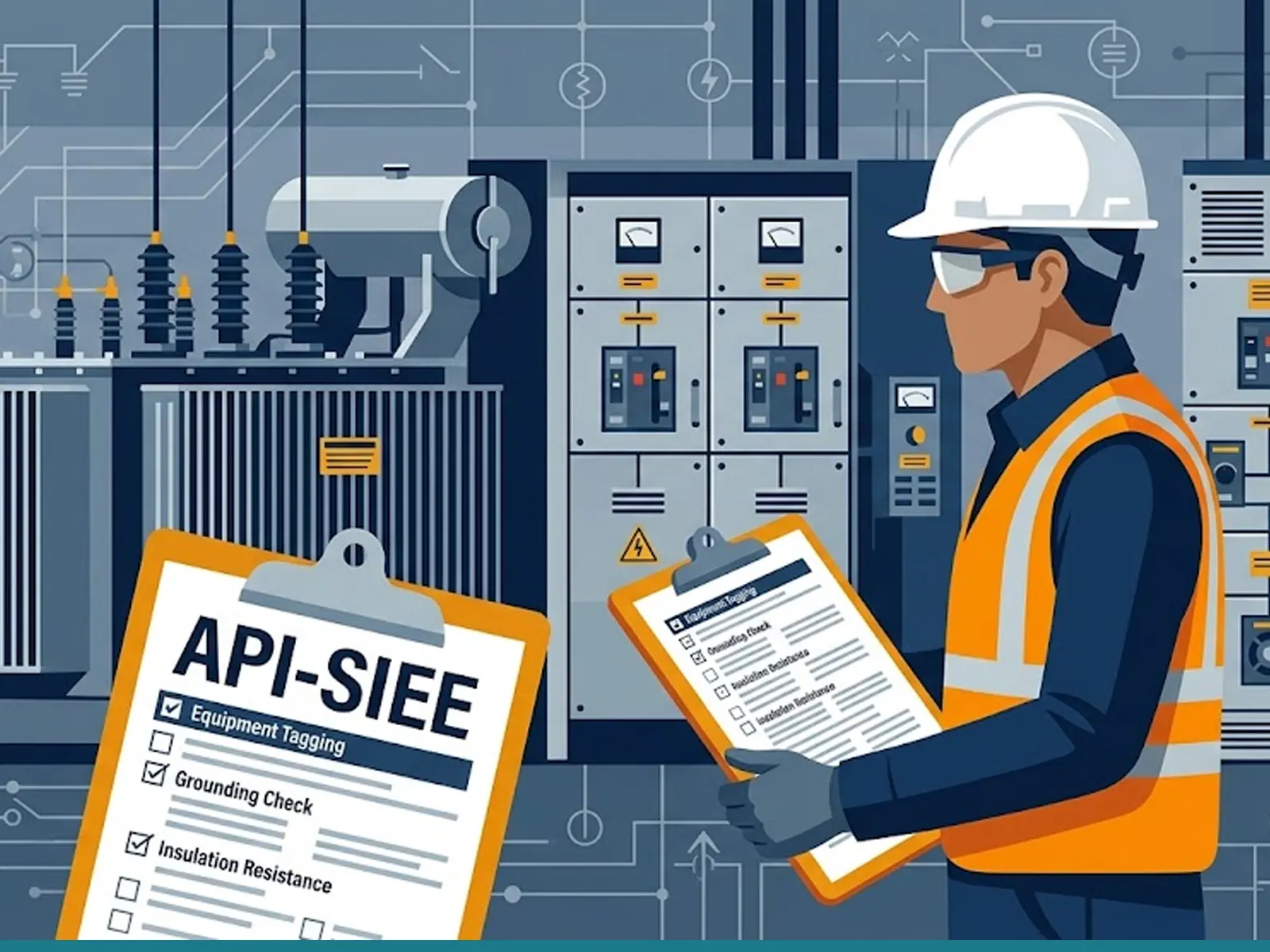
Struggling to pass the API-SIEE exam on your first try? This guide walks you through real API-SIEE mockup questions, all five exam domains, eligibility requirements, and a study plan that actually works — so you walk into that test center knowing exactly what to expect.
Let me be honest with you - the API SIEE exam is not something you crack by skimming a few PDFs the week before. People with years of field experience underestimate it and walk out without a passing score. The exam is closed-book, timed, and built around scenarios that require actual judgment, not just memory.
This guide breaks down everything: what the certification is, who qualifies, exactly what the exam tests, and how to build a prep strategy that works. At the end, you'll find five API-SIEE mockup questions with full explanations - the kind that show you why an answer is right, not just which letter to pick.
The full name is Source Inspector Electrical Equipment. It's issued by the American Petroleum Institute under their Individual Certification Programs - the same body behind API 510, API 570, and the rest of the ICP family.
Here's the core idea: when a petrochemical company orders a transformer or a motor control center, someone has to go to the manufacturer's facility and verify the equipment is built right - before it ships. That's the source inspector. You're not reviewing paperwork from an office. You're on the shop floor, watching fabrication, checking test results, signing off on hold points.
The SIEE specifically qualifies you for electrical equipment: transformers, switchgear, motor control centers, control panels, junction boxes, electrical systems, and electric motors over 500 HP. The API SIFE covers fixed equipment like pressure vessels. The SIRE covers rotating machinery like pumps and compressors. All three sit in the same Source Inspector suite, and holding one can reduce the experience requirement to earn the others.
Certification is valid for three years. Miss the 90-day recertification window after expiry and you're starting fresh - new application, new exam.
This catches a lot of people off guard. The API SIEE is not open-entry. You can't just pay the fee and schedule a seat. API reviews your background first, and your documented experience has to pass their prequalification check before you get anywhere near a test center.
How much experience you need depends on your education:
| Education Background | Minimum Experience Required |
|---|---|
| Bachelor's degree in Electrical Engineering | 2 years |
| Associate's degree or 2-year technical program | 3 years |
| High School diploma | 5 years |
| Licensed Master or Journeyman Electrician | 5 years |
The experience doesn't have to come from oil and gas. Electrical inspection work in power generation, nuclear, military, commercial, or industrial settings all qualifies - as long as it's real, documented, and verifiable on your application.
Worth knowing: if you already hold the SIFE or SIRE certification, your experience requirement for SIEE drops. High school diploma holders go from five years down to three. It's a meaningful reduction if you're building toward the full Source Inspector suite.
Once API approves your prequalification, here's the setup:
That works out to roughly two minutes per question. Most questions won't need that long. The scenario-based ones - where you reason through a realistic inspection situation rather than recall a definition - eat the most time. Those also separate people who studied hard from people who actually understand the work.
API uses scaled scoring, so the exact passing mark isn't published as a flat percentage. Candidates who consistently score 70–75% on well-built practice sets tend to pass the real thing. If you're hitting 65% on mockups and calling yourself ready, you're not ready.
API publishes a Body of Knowledge for the SIEE - a document listing every topic the exam can test. The 2024 version is valid through August 2026 exams. Five domains. Each one tests differently.
Sounds basic. It isn't - not when two answer choices look almost identical because of a single word. This section covers precise inspection terminology, equipment classifications, and the technical vocabulary used across API, IEEE, NEMA, NETA, and NFPA publications.
Field experience doesn't automatically cover this. The exam uses specific API-defined language, not the informal shorthand you use on site. Flashcards work better here than re-reading paragraphs. Make them early. Use them daily.
This covers how inspection programs are structured, what authority an inspector actually holds, and how vendor quality management systems get evaluated. Questions cover purchaser requirements, how Inspection and Test Plans (ITPs) are developed, and correct protocols for each phase of an inspection engagement.
People who've passed consistently describe this section as definition-heavy. One candidate who cleared the exam on her first attempt said she reviewed management program flashcards every morning for three weeks. That kind of repetition paid off for her.
Here's where the exam makes you think, not just recall. You'll assess equipment risk, develop inspection project plans, and make accept/reject decisions based on documented criteria. Scenario questions ask you to rank failure modes, apply basic FMEA logic, and justify decisions using risk matrices.
The core concept: risk is probability times consequence. A low-probability failure on offshore equipment still demands rigorous inspection because the consequence is catastrophic. Questions test whether you understand that relationship - not just whether you can define the terms.
The largest section, and by most accounts the most demanding. It covers the full lifecycle of a real inspection:
If you can mentally walk through a complete inspection - from pre-inspection meeting to final sign-off - this section won't surprise you. If your experience is patchy in any of these areas, this is where you'll feel it on exam day.
The technical side. Specific techniques you need to know cold:
Transformer questions deserve extra attention. Expect to interpret oil test results, understand dissolved gas analysis (DGA) basics, and recognize nameplate rating criteria and cooling class designations. These come up more than most candidates anticipate.
The exam pulls from a specific Publications Effectivity Sheet - download it from API's website and treat it as your master reading list. The key standards families:
You don't need to memorize every clause. You need to know which standard governs which equipment type and what the key acceptance thresholds are. Cross-reference the Effectivity Sheet with the BOK before you start studying - that gives you a prioritized reading list, not a mountain of documents.
Here's a sequence that works:
Week 1–2: Download the BOK and rate your confidence on every topic - strong, shaky, or blank. That's your gap analysis. Study from weakness, not habit.
Week 3–4: Work through the SIEE Study Guide cover to cover. Build flashcards for Domains 1 and 2 simultaneously. Don't skip the definitions chapters just because they feel dry.
Week 5–6: Go through the Effectivity Sheet publications. Focus on acceptance criteria and testing requirements - the specific numbers and thresholds that show up in exam questions.
Week 7–8: Timed API-SIEE mockup questions. Full 100-question sessions. Clock running. Closed book. Anything less is not actual exam practice.
Final week: Weak spots only. Your practice scores will tell you exactly where you're losing points. Spend this time there - not reviewing what you already know.
Book your exam when you're consistently clearing 75% on full timed sets. Not 70. The real exam is worded harder, and edge cases cost you 5–10 points compared to most prep materials.
Five questions - one from each exam domain. These match the format, difficulty, and reasoning style of the actual test.
Question 1 - Terms and Definitions
A purchaser's representative visiting a vendor's manufacturing facility to verify that fabrication processes comply with contractual and technical specification requirements is best described as:
A) A quality auditor B) A source inspector C) A third-party surveyor D) A compliance officer
Answer: B
A source inspector works at the supplier's facility, on behalf of the purchaser, to confirm equipment meets contractual requirements. Quality auditors evaluate management systems, not specific fabrication activities. "Third-party surveyor" gets used informally in the field but isn't the API-defined term. This section tests precise API vocabulary - near-synonyms don't count.
Question 2 - Source Inspection Management Program
Prior to beginning a source inspection on a high-voltage switchgear order, which document defines the specific hold points, witness points, and review points the inspector must follow?
A) The purchase order B) The Inspection and Test Plan (ITP) C) The vendor's data book D) The Factory Acceptance Test procedure
Answer: B
The ITP maps out exactly when an inspector must be present and what level of involvement is required at each stage. A hold point means work cannot proceed without the inspector's sign-off. A witness point means the inspector should be present but work can continue after notification. A review point means document check only. The purchase order covers commercial terms - it doesn't sequence inspection activities.
Question 3 - Equipment Risk Assessment
During a risk assessment for a 2,500 kVA liquid-immersed transformer headed to an offshore oil platform, an inspector determines that the consequence of failure is high but the probability of failure is low. What is the correct approach?
A) Accept the equipment without additional inspection since the probability of failure is low B) Increase inspection intensity and apply additional hold points given the high consequence C) Reject the equipment outright until the probability of failure is reduced to zero D) Escalate the decision to the vendor's quality manager
Answer: B
Risk combines probability and consequence - neither one alone drives the decision. An offshore transformer failure can mean loss of life, environmental damage, and a production shutdown. That consequence profile demands thorough inspection, regardless of how unlikely the failure seems. Option A is the mistake people make when they focus only on probability. Option C is an overreach - you adjust inspection intensity based on risk, you don't reject equipment because a risk exists.
Question 4 - Source Inspection Performance
During a factory inspection of a motor control center, the inspector finds that a component has been replaced with a different manufacturer's part. The substitution was never submitted to or approved by the Material Review Board. The inspector should:
A) Accept the substitution if the component looks functionally equivalent B) Issue a nonconformance report and notify the purchaser C) Instruct the vendor to remove and replace the component immediately D) Accept the component if the vendor provides a manufacturer's certificate
Answer: B
The inspector documents and reports. An unapproved substitution is a nonconformance against the contract - full stop. The inspector doesn't have authority to independently approve deviations or issue corrective action orders beyond what the ITP specifies. The purchaser decides what happens next: waiver, replacement, or rejection. Option C might feel decisive, but an inspector issuing unilateral instructions to a vendor outside the defined process is overstepping. Option A completely bypasses the contractual process.
Question 5 - Examination Methods, Tools, and Equipment
An inspector performing insulation resistance testing on a 600V motor finds that the reading is significantly below the manufacturer's baseline from six months earlier. What is the most appropriate immediate next step?
A) Reject the motor and return it to the manufacturer B) Dry out the motor and retest to check for moisture C) Accept the motor since the reading still exceeds the minimum code threshold D) Apply a temperature correction factor and compare the adjusted result to the original baseline
Answer: D
Insulation resistance is temperature-sensitive. A test at 10°C and one at 40°C on the same motor will produce different readings. Before drawing any conclusion, apply the standard temperature correction factor so the current reading is comparable to the baseline. If the adjusted value is still anomalously low, drying and retesting - Option B - becomes the logical follow-up. Rejecting immediately without investigation is premature. Accepting just because a minimum threshold is met, without understanding why the value dropped, misses the entire point of comparative baseline testing.
A few resources worth using: Udemy has a 500-question prep course built around inspection scenarios with explanations. Pass4Success and PassQuestion both offer timed question engines updated through 2026. CertEmpire provides a 110-question PDF and simulator calibrated to the closed-book exam format.
One firm rule: verify that whatever resource you use references the 2024 BOK and the current Publications Effectivity Sheet. Older prep material - anything pre-2024 - may reference standards that have since been revised. Wrong-version prep is worse than no prep, because it builds false confidence around outdated content.
API's own SIEE Study Guide is the foundation. Everything else supplements it.
The API-SIEE is a real credential. It takes documented experience to qualify for it, structured preparation to pass it, and consistent practice to walk in confident. But it's genuinely achievable - candidates pass on their first attempt all the time. The ones who do follow the same pattern: systematic BOK study, timed API-SIEE mockup question practice, and the discipline to not schedule the exam until their scores say they're actually ready.
Use the five questions above to calibrate where you stand right now. Solid on all five? Move to full timed practice sets. Shaky on two or more? Go back to the matching BOK domain and close that gap before you go further.
The certification opens real doors in oil and gas, petrochemical, power generation, and offshore. The inspectors who hold it are valued because the work is specific, consequential, and not everyone can do it well.
Prepare accordingly.